





A codependent relationship is an imbalance, a dysfunctional condition where an individual sacrifices their own identity, needs, or well-being. You face a lot of problems that go beyond substance use disorder when your partner develops addiction. One of the toughest problems that many couples have to deal with is codependency.
This is when partners rely on one another emotionally in unhealthy ways. Codependency makes it difficult to recover, as it leads to actions that make things worse. These include poor communication, mistrust, and an unbreakable cycle.
✨ Highlights:
- Codependency is a condition of depending on others for emotional balance and sense of identity.
- Break the codependency in relationships by recognizing and accepting the problem with healthy boundaries and interdependence.
- Open and honest communication is essential to prevent codependent relationships without enabling behavior.
- Consider the couple rehab to break the cycle of codependency.
House of Zen offers couples therapy, making it possible to break away from codependency by making your unhealthy relationships stronger and healthier, and helps you stay sober longer. It is important to learn how to overcome codependency in a relationship.
What Is Codependency?
Codependency is a situation where one or both partners rely too much on the other for their sense of identity and emotional health. A codependent partner typically puts their partner’s needs before their own. Such behaviors in codependency lead to unhealthy patterns like drug or alcohol consumption without you even realizing it.
A codependent relationship doesn’t help either partner. Instead, they keep them both locked in unhealthy and self-destructive behavior, making addiction recovery difficult. Two individuals stuck in a cycle where one is addicted, and the other continues saving or protecting them, even if it hurts them, is not good.
The partner who enables such behavior might feel wanted and important. But this usually means that the spouse who is addicted never really has to deal with the consequences of their behavior. As a result, neither partner grows or fully recovers completely.
Finding it Hard to Prevent Yourself from a Codependent Relationship?
Consider the couple therapy sessions from the House of Zen to break the codependency in relationships.
How Codependency Makes Addiction Worse
Addiction thrives in codependent relationships, which provide it with breeding grounds to grow. Couples who are both addicted or where one partner is addicted and the other is codependent do not want to quit.
This is primarily because this unhealthy cycle of dependence feels safe and familiar to them. Codependency makes it hard for couples to say no or establish limits since it seems like a violation of personal boundaries. This typically leads to a “cycle of enabling,” when one partner’s addiction is unintentionally supported.
The codependent person could lie or make excuses for the other person. They might attempt to control the behavior of the addicted partner or put their own needs below their partner’s, without dealing with the actual problem. Over time, this leads to anger, irritation, and a loss of trust.
Codependent behavior creates destructive patterns leading to complex relationship problems. Therefore, individuals need to consider how to stop codependency and maintain healthy relationships and addiction treatment by qualified rehab professionals.
The Emotional Toll:
Codependency isn’t only about individuals’ behaviours; it also has an effect on how they feel. Many codependent people feel guilty, ashamed, or have low self-esteem because they fear that they won’t be loved if they put their own needs first. This might even lose their sense of identity.
The addicted partner can feel stuck or misunderstood, which makes them want to use drugs or alcohol more often to get away from their emotional suffering. People in such relationships usually do not communicate well and develop codependent tendencies.
Individuals avoid honest conversations due to fears of conflict or rejection, or to shield one another from harsh reality. This stops development and growth instead of encouraging it. That’s why people need to consider how to fix codependency.
What is the Importance of Overcoming Codependency?
Breaking out of codependency is important for both your recovery and the health of your relationship. If not dealt with properly, codependency gets in the way of recovery and makes both partners vulnerable to relapse.
When couples look to break these behaviors, they not only help each other stay sober. But they also develop a foundation of trust and respect. Relationships based on healthy interdependence instead of codependence.
There is a much better chance of surviving bad times. Breaking the cycle of codependent relationships is necessary for your recovery process. Therefore, it is important to learn how to beat codependency.
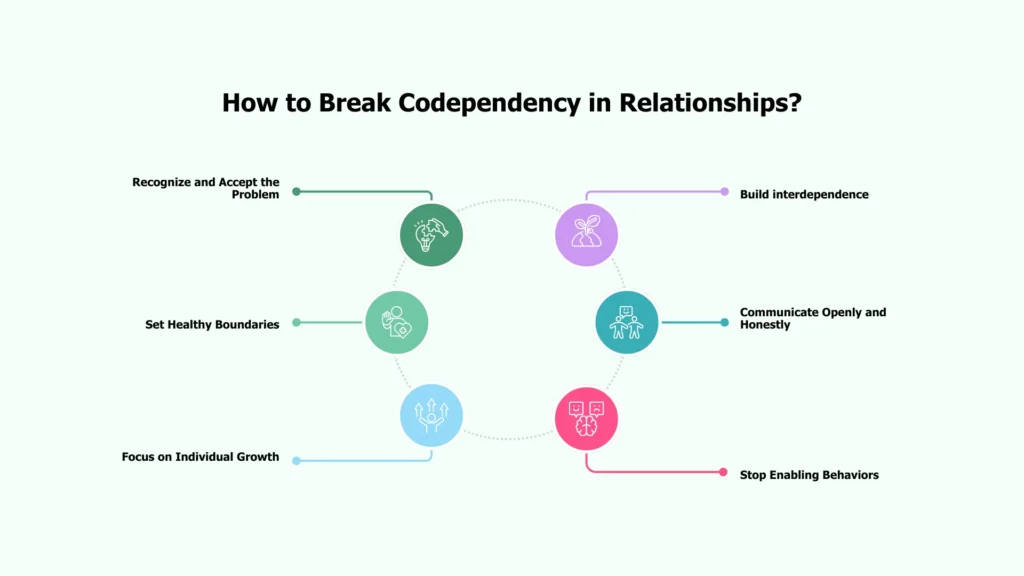
How to Break Codependency in Relationships?
Breaking the pattern of codependency might seem impossible, but couples can make their relationship better with commitment and the appropriate strategy. You can consider crucial steps for how to get over codependency. Here are some important things to do for your recovery process:
1. Recognize and Accept the Problem:
The first step is to acknowledge that codependency exists in the relationship. This acknowledgment is essential and requires honesty with oneself and the relationship. It’s difficult to make meaningful change without this.
2. Set Healthy Boundaries:
Boundaries are limits that keep everyone safe and prioritize personal well-being. In codependent relationships, these boundaries are either weak or do not exist at all. An important part of recovery is establishing boundaries and respecting each other’s needs, even when it’s hard. Mutual respect is an important part of setting healthy boundaries.
3. Focus on Individual Growth:
Both partners should focus on their individual recovery as well as on the relationship. This includes going to therapy, taking care of yourself, and building up your self-esteem without depending on the other person. That’s why emotional regulation is a big part of your growth as an individual.
4. Build interdependence:
In healthy relationship dynamics, connection and individuality are well-balanced. Partners can help one another without giving up their independence. This means that you can trust each other to deal with difficulties and feelings without having to fix everything by yourself.
5. Communicate Openly and Honestly:
The key to recovery in a relationship is to communicate with each other honestly. Couples should learn how to share their emotions without blaming each other, listen carefully, and say what they need to hear.
6. Stop Enabling Behaviors:
This step can be tough. It means not hiding or making excuses for addictive behaviors anymore. Partners should instead promote responsibility and accept the consequences while still offering support in healthy ways.
How Couples Rehab Helps End the Cycle of Codependency
Couples’ recovery programs are intended to help couples who want to learn how to unlearn codependency together. Couples treatment in a residential program is different from regular rehab, as it addresses both the addiction and the relationship at the same time.
Individual and Couples Therapy:
Therapy is the most important part of getting over codependency. Individual therapy helps every couple identify their own problems, learn about their triggers, and understand how they feel about themselves.
Couples therapy is all about the relationship and how to improve communication, trust, and respect in a better way. Therapy fosters open communication and mutual respect between couples, leading to a more fulfilling relationship.
Behavioral Therapies:
Cognitive Behavioral Therapy (CBT) is one of the many techniques that programs use to help partners recognize and change the negative thinking patterns that keep them engaged in codependent behaviors. You can break long-lasting, destructive habits by learning new methods to deal with stress and cravings.
Relapse Prevention Focused on the Relationship:
Therapists help couples learn to recognize early indicators of a relapse, whether it’s for addiction or in their relationship issues. Couples learn how to help one another and be there as a support group. That’s why stopping codependency is essential to prevent relapse.
Building Skills For Healthy Relationships:
Couples rehab teaches more than just how to stop using drugs. It also teaches useful skills like how to deal with problems, set limits, and control your emotions. These strategies help couples safely reestablish trust and intimacy. It teaches them not to put their personal needs above their partner’s happiness.
What Recovery Looks Like After Breaking Codependency
Recovery is a journey, not a quick fix. You might experience these after breaking your codependency in couples rehab:
- Greater emotional freedom
- Better communication and problem-solving
- Increased trust and intimacy
- A healthy relationship balance between support and independence
- Lower chance of relapse due to coping skills
Therapy sessions, support groups, and continuous personal work are all important parts of continued treatment.
Get Help Now from the House of Zen If You are Struggling with a Codependent Relationship.
The Role of Support Networks
Support from others outside your relationship, such as family members, is very important. Support from friends, family, and peer groups can give you new perspectives and help you stay strong. These networks help couples maintain boundaries and be responsible.
Couples addicted to drugs or alcohol and are codependent on each other have a significant problem, but it doesn’t have to last forever. Couples can break the cycle by identifying unhealthy patterns, practicing new relationship skills, and getting professional therapy together.
Break the Cycle of Codependent Relationships
Breaking codependency offers long-lasting recovery when both partners recover on their own and as a team. Couples develop a solid foundation for a better future by working hard, being patient, and getting help. This foundation should be established on love, respect, and real connection, not codependence.
Therapists at the House of Zen recognize patterns and provide professional guidance to couples to promote healthier connections. The journey may be hard, but every step is worth it. To break the pattern of codependency, you need to do more than simply stop doing things that hurt you.
You need to build a loving, long-lasting, healthy relationship for the wellness of both of you. Couples learn what it really means to support one another for sustained recovery from substance use disorder.
Top Questions About Codependent Relationships
Discover answers to frequently asked questions about codependent relationships.
How do you break codependency?
You can break codependency by:
● Recognizing and accepting the problem
● Setting healthy boundaries
● Focusing on growth
● Building interdependence
● Maintaining honest communication
● Stopping enabling behaviors
What are the 5 core symptoms of codependency?
The 5 core symptoms of codependency are:
1. Poor boundaries
2. Control problems
3. Lower self-esteem
4. People-pleasing behavior
5. Reality expression difficulty
What are the 4 types of codependency?
The 4 types of codependency are:
1. Caretaker
2. Controller
3. Enabler
4. Adjuster
What is a toxic codependent relationship?
A toxic codependent relationship is a detrimental relationship where an individual prioritizes their needs over others’ needs.
What does a codependent relationship feel like?
A codependent relationship feels like a severe emotional imbalance where an individual’s actions and mood affect others.
What is mistaken for codependency?
Codependency is mistaken for positive relationship characteristics like deep love and extreme empathy.
