







You may require help from an out-of-network provider when an in-network provider does not offer the treatment you are looking for. However, out-of-network treatment costs more than in-network coverage, and you need to consider a single-case agreement. But what is a single-case agreement rehab? It’s a one-time, temporary agreement between the insurance company and out-of-network facilities to allow a specific individual to receive care with in-network benefits. The successful single-case agreement for addiction treatment lowers the out-of-pocket costs.
✨ Key Takeaways:
- Request a single-case agreement to access out-of-network coverage with in-network benefits.
- Understand the workflow of SCA for the addiction treatment coverage.
- Explore the difference between SCA and gap exceptions for rehabilitation.
- Insurance provider grants SCA for network inadequacy, continuity of care, and clinical specificity.
What is a Single Case Agreement (SCA)?
A single case agreement, also known as an out-of-network exception or single case exception, allows individuals to access out-of-network coverage due to a contract between the insurer and an out-of-network provider. The negotiation between the healthcare provider and the insurance provider to help an individual access drug and alcohol addiction treatment with in-network coverage.
Both the insurance company and rehab facility agree on the covered treatment services and charges for the individual case. It is important to remember that SCA is different from both in-network and out-of-network coverage. Single case agreement is usually determined on a case-by-case basis. SCA is not always guaranteed because factors like plan policies, medical necessity, and availability of comparable in-network care affect its approval for addiction treatment.
What Does a Single Case Agreement (SCA) Cover?
A single-case agreement usually covers out-of-network treatment and defined services under temporary in-network coverage. This agreement usually provides coverage for only a named individual and is strictly applicable to out-of-network providers. It is often approved for services that are not being provided by in-network providers for addiction rehabilitation, including residential treatment and therapy sessions. SCA offers coverage with lower out-of-pocket costs for the specified duration of the substance use disorder treatment.
Why Does an Insurer Approve a Single Case Agreement for Rehab?
An insurance provider approves a Single-Case Agreement (SCA) rehab when specialized or out-of-network care becomes necessary for an individual while an in-network provider cannot offer that service. A lack of adequate in-network coverage that offers the required level of care forces the insurer to consider an SCA. The insurance company needs to provide SCA approval when in-network programs are full and an individual experiences delayed access or waiting time.
Individuals can also receive the single-case agreement when they need dual diagnosis treatment to address substance use disorder and co-occurring mental health conditions. The continuity of care, like stepping down from inpatient to a partial hospitalization program, is also possible with the valid single-case agreement. The unavailability of local rehab facilities also requires insurance companies to grant SCA for streamlined substance addiction treatment.
Struggling to Get SCA Approval for Addiction Rehab?
Get help from House of Zen to streamline the process for a smooth single-agreement rehab approval.
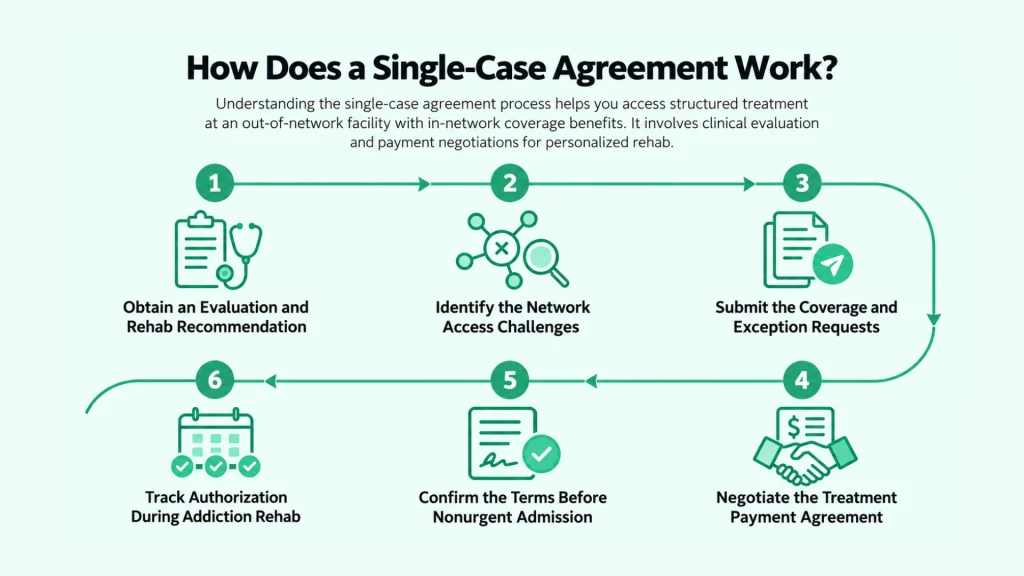
How Does a Single-Case Agreement Work?
Understanding the single-case agreement process helps you access structured treatment at an out-of-network facility with in-network coverage benefits. It involves clinical evaluation and payment negotiations for personalized rehab.
1. Obtain an Evaluation and Rehab Recommendation
A qualified and licensed team assesses an individual’s symptoms of substance use disorder, addiction history, potential withdrawal risk, mental health conditions, medical record, and recovery goals. This thorough evaluation determines the required level of care that is medically appropriate for smooth recovery.
2. Identify the Network Access Challenges
It is important to ask the insurance provider for suitable network options with seamless insurance coverage. You can also document your discussions with the rehab facilities rather than making your own assumption of unavailability of treatment. This documentation helps you explain that required rehab services are missing.
3. Submit the Coverage and Exception Requests
You can receive medical necessity certification from the rehab facility and submit it to the insurance provider for prior authorization. Moreover, you have to request a network exception for your addiction treatment. You can also discuss the documentation process and expected timeline of the decision for a single-case agreement.
4. Negotiate the Treatment Payment Agreement
The insurance provider and rehab facility negotiate the billing and reimbursement terms when the provider is ready to provide the single-case agreement treatment. An insurance company’s willingness to consider the request does not mean the rehab service is agreed to at the rate. Treatment is available only when both parties agree.
5. Confirm the Terms Before Nonurgent Admission
You should consider a written clinical confirmation before entering the rehab facility. It’s important to review the approved services, cost sharing, treatment dates, and other conditions carefully. Requesting written documentation and a contract is essential rather than verbal approval for addiction rehabilitation services.
6. Track Authorization During Addiction Rehab
You may remember that initial approval is available only for a limited time. Continued addiction treatment may require additional review and updated clinical records. You should know how a rehab center tracks treatment authorization, communicates coverage days, and financial responsibility.
Single Case Agreement VS Standard Out-of-Network Coverage
A single-case agreement is a temporary contract that allows individuals to access addiction treatment at an out-of-network provider with in-network benefits. It is a negotiated arrangement to bring cost-sharing to the in-network coverage. Out-of-network coverage for addiction treatment depends on the insurance provider’s out-of-network benefits. It involves higher coinsurance, copays, deductibles, and out-of-pocket maximums. That’s why coverage is different for both out-of-network providers and single-case agreements.
| Feature | Out-of-Network Coverage | Single-Case Agreement |
| Agreement Type | One-time | Standard |
| Cost-Sharing | High out-of-pocket | Low out-of-pocket |
| Reimbursement | Percentage of billing | Pre-negotiated rates |
| Balance Billing | Higher risk | Protected |
| Approval | Automatic | Active justification |
| Scope | Ongoing | Limited |
What is the Difference Between Gap Exception and a Single Case Agreement?
Single-Case Agreement (SCA) and gap exception help you access addiction rehab in different conditions from out-of-network providers. They are closely linked and can be used together for substance use disorder treatment. A gap exception requires the plan to cover out-of-network treatment services at an in-network rate. SCA is a formal contract negotiated between an insurance company and a treatment center.
Here are two major differences between a Single-Case Agreement (SCA) and a gap exception.
Primary Trigger
Insurance providers grant out-of-network coverage when a genuine gap exists, such as a lack of in-network providers, specialized care, and unreasonable waiting time. A single-case agreement is pursued when in-network providers do not technically provide the required rehab services for addiction recovery.
Control
Gap exception for addiction rehabilitation focuses on an individual’s benefit status, such as cost-sharing options like copays, deductibles, and coinsurance for out-of-network coverage. A single-case agreement focuses on the one-time or temporary contract between the insurer and the rehab center to negotiate the treatment timeline, covered services, and reimbursement rate.
How Do Single Case Agreements Work With Medicaid and Medicare?
Understanding how single-case agreements work with Medicare and Medicaid helps you receive out-of-network care through a contract between the insurance payer and rehab facility. It allows you to receive the required care at the agreed-upon cost-sharing rates and in-network benefits.
Single Case Agreement With Medicaid
Medicaid programs and Medicaid Managed Care Organizations (MCOs) allow single-case agreements for substance use disorder treatment coverage. SCA with Medicaid works when individuals need effective addiction treatment and specialized services that are not available at in-network providers.
A single-case agreement is an authorized approach for care coverage because Medicaid does not offer out-of-network coverage. Individuals may submit the request for an SCA through Medicaid MCO, clinical documentation, and rate negotiation.
Single Case Agreement With Medicare
Traditional Medicare does not offer single-case agreements for alcohol and drug addiction treatment. SCA cannot bridge the gap because Medicare offers rehab services at Medicaid-approved rates.
Medicare Advantage plans may use SCA-like arrangements called gap exceptions for substance abuse treatment. Moreover, Medicare Advantage plans may offer a gap exception when an individual requires specialized care that the plan does not provide. Individuals need to fill out a network gap exception form for addiction rehabilitation.
When Insurance Providers Grant Single Case Agreements
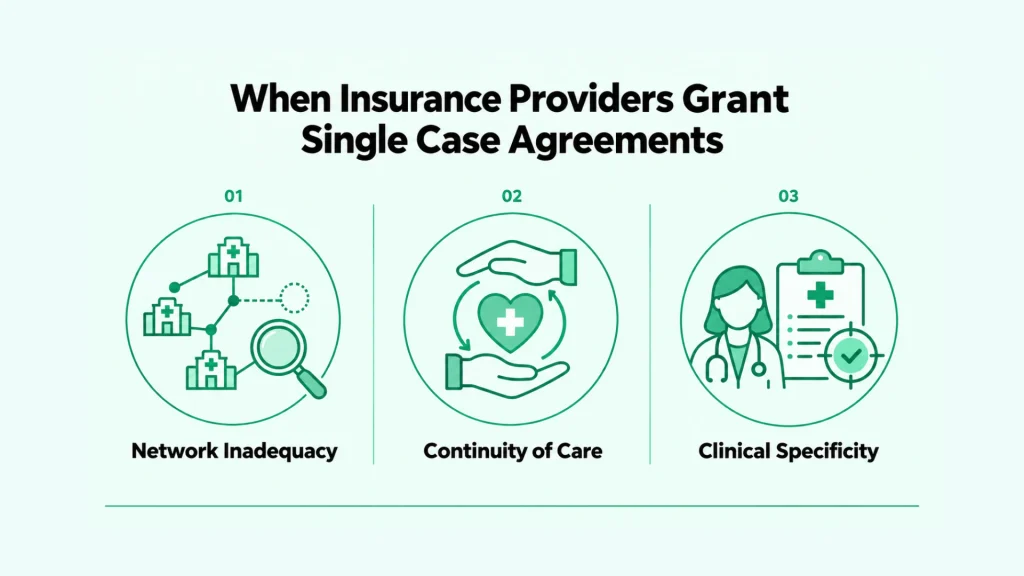
Insurance providers grant a Single-Case Agreement (SCA) when it becomes medically necessary to seek treatment from an out-of-network facility or provider. The main reasons for granting an SCA are network inadequacy, continuity of care, and clinical specificity.
Network Inadequacy
The insurance provider network has no appropriate rehab facility for medically necessary addiction rehab. This means individuals do not have access to the ideal treatment within a reasonable distance. Network inadequacy is the main reason for a successful single-case agreement rehab.
Continuity of Care
You were already in a network that was providing the required care at a level of care for addiction treatment. However, the rehab facility does not provide care when you are stepping down to another or lower level of care. In this case, you will be granted SCA for the continuity of care for long-term recovery.
Clinical Specificity
You can request a Single-Case Agreement (SCA) rehab when an in-network provider cannot facilitate your documented clinical needs. The specific and well-documented specificity is required to make the request stronger. Therefore, you can receive the specialized care by obtaining an SCA.
How to Request a Single Case Agreement for Addiction Rehab
You need to talk with both the insurance provider and the out-of-network rehab facility. Clear communication and documentation are essential to request and obtain a single-case agreement for substance use disorder rehab. Here are steps for requesting an SCA:
- Talk to a Rehab Facility: You need to get in touch with the out-of-network provider to confirm if they accept your insurance.
- Contact Insurance Company: Find and call the number available on the back of your insurance card to discuss SCA.
- Insurance Negotiation: Insurance providers often review your request and negotiate with the rehab facility for treatment.
- Approval for Care: You will become eligible for treatment with temporary in-network benefits after the approval of SCA.
💡 Did You Know
Negotiated SCA rates are approximately 30% to 50% higher than in-network rehabilitation coverage.
What Documents Strengthen an SCA Request for Treatment?
Medical necessity, treatment costs, and network inadequacy encourage individuals to consider the single-case agreement treatment. Important documents often explain why SCA is required for addiction recovery.
- Current clinical evaluation
- Treatment history
- Contact log of out-of-network facilities
- A summary of required services
- A treatment transition plan
How Long Does an SCA Last for an Addiction Rehabilitation Program?
A single-case agreement usually lasts for 30 to 90 days in the case of inpatient or residential treatment for addiction. However, it can last for weeks for a partial hospitalization program or an intensive outpatient program. You should remember that SCA for addiction treatment may last for the approved duration. The exact duration of a single-case agreement is often available in the contract. This means you may need to request another SCA if you still need care at an out-of-network provider.
What are the Causes for Single Case Agreement (SCA) Denial?
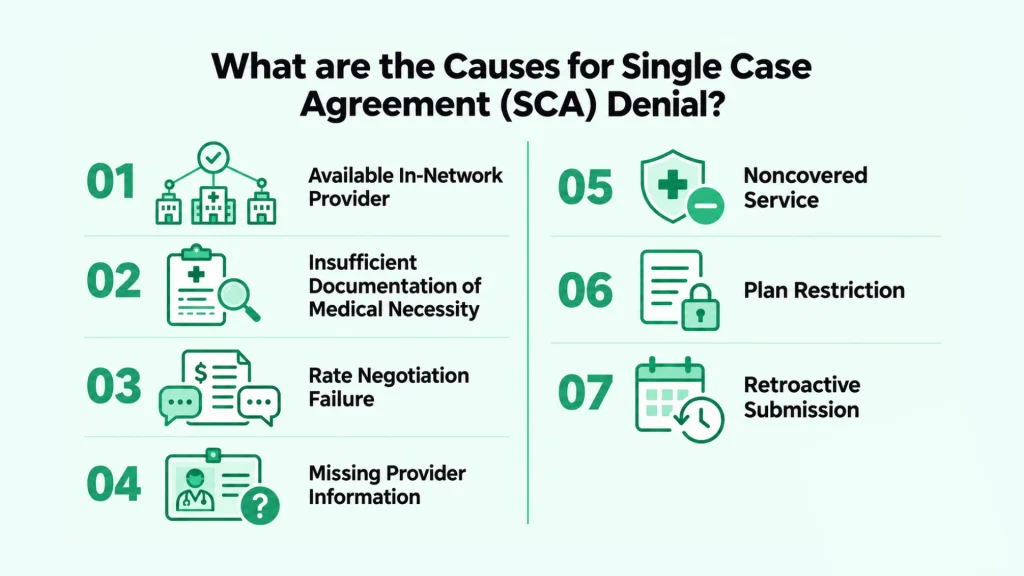
An available in-network provider, insufficient documentation of medical necessity, rate negotiation failure, missing provider information, noncovered service, plan restriction, and retroactive submission are major reasons for denial of a single-case agreement. Understanding these causes is important when you are looking to obtain an SCA for addiction rehabilitation.
Available In-Network Provider
The insurance provider has an in-network rehab facility that specializes in the treatment you are looking for. This also means that you can receive the same treatment through an in-network provider within a reasonable distance, usually 30 miles, and wait-time limits of approximately 10 to 14 days.
Insufficient Documentation of Medical Necessity
The failure of clinical documentation proves why specialized out-of-network addiction care is medically required instead of in-network coverage. Insufficient medical necessity documentation is a major reason why insurance providers and rehab facilities cannot agree on the single-case agreement.
Rate Negotiation Failure
The potential reason for denial of an SCA for addiction rehab is also the failure of rate negotiation. Both the rehab center and insurance company may not agree on addiction treatment rates. That’s why individuals cannot receive the required care with in-network benefits at an out-of-network provider.
Missing Provider Information
The request for a single-case agreement may miss important details such as the provider’s National Provider Identifier (NPI), licensing credentials, tax ID, and signed patient consent forms. That’s why missing provider information is also a prominent reason for an SCA rehabilitation denial.
Noncovered Service
The requested level of care or service is excluded from the insurance company’s policy. This means a single-case agreement is not capable of overriding the provider’s policy for the addiction treatment. That’s why individuals may experience a denial of a single-case agreement for out-of-network treatment coverage.
Plan Restriction
The individual’s health plans, such as traditional Medicare plans or specific self-funded employer plans, may not allow single-case agreements or out-of-network exceptions. This means plan restrictions are a major cause of restricting you from seeking addiction treatment with SCA.
Retroactive Submission
Submitting a request for a single-case agreement after treatment began is also a potential cause of denial. That means securing a written SCA before starting treatment should be your priority. Some insurance plans offer retroactive exceptions to individuals under specific conditions.
How Can House of Zen Help You After SCA Rehab Denial?
The professional team at House of Zen LA can help you file a formal internal appeal when your request for a single-case agreement is denied. We can also assist you with a peer-to-peer review and filing a complaint with the state insurance board. Our team may ask you to request the written denial details from the insurance provider explaining the criteria and exact reasons for denial.
The certified professionals at our luxury rehab center help individuals identify potential reasons, including insufficient documentation, in-network availability, missing provider details, rate negotiation failure, plan restriction, noncovered service, and retroactive submission. We help you address these causes to secure SCA approval and explore reliable out-of-pocket coverage options for a smooth treatment experience.
Access SCA-Approved Rehab at House of Zen
Contact us today and start your treatment with a single-case agreement at House of Zen LA.
Start Your Rehab at House of Zen with a Single Case Agreement
Understanding a single-case agreement allows you to access out-of-network treatment with in-network benefits. At House of Zen, we are committed to providing the care required for individuals with an approved SCA for addiction rehab. Our team also helps with obtaining a single-case agreement for substance use disorder treatment through inpatient and intensive outpatient programs to focus on smooth recovery. Let’s schedule your appointment today and receive personalized care for lasting sobriety!
Answers to Common Questions About Single Case Agreement Rehab
Frequently asked questions about a single-case agreement rehab are answered here.
What is the purpose of a single case agreement?
The purpose of a Single-Case Agreement (SCA) is to provide one-time, temporary access to out-of-network coverage with in-network benefits in case of inadequate in-network coverage.
How long does a single-case agreement last?
A single-case agreement is a temporary contract, and the duration of SCA depends on the approved number of days for treatment and clinical needs during addiction treatment.
What is the difference between a single-case agreement and prior authorization?
A single-case agreement is a one-time contract between an out-of-network rehab facility and an insurance provider for a specific individual. A prior authorization is a clinical approval from an insurance company for treatment coverage.
How to obtain a single-case agreement?
You or an out-of-network rehabilitation facility need to contact the insurance provider and submit the required documentation to obtain a single-case agreement to receive the specialized care.
Is a single-case agreement the same as a gap exception?
No, a single-case agreement is not the same as a gap exception. A single-case agreement is a one-time, temporary contract for out-of-network treatment with in-network benefits. A gap exception offers out-of-network treatment as an insurance benefit.
Who initiates a single case agreement?
An individual or insurance provider usually initiates a single-case agreement for addiction treatment at an out-of-network facility. However, the insurance provider has more control over the single-case agreement.
